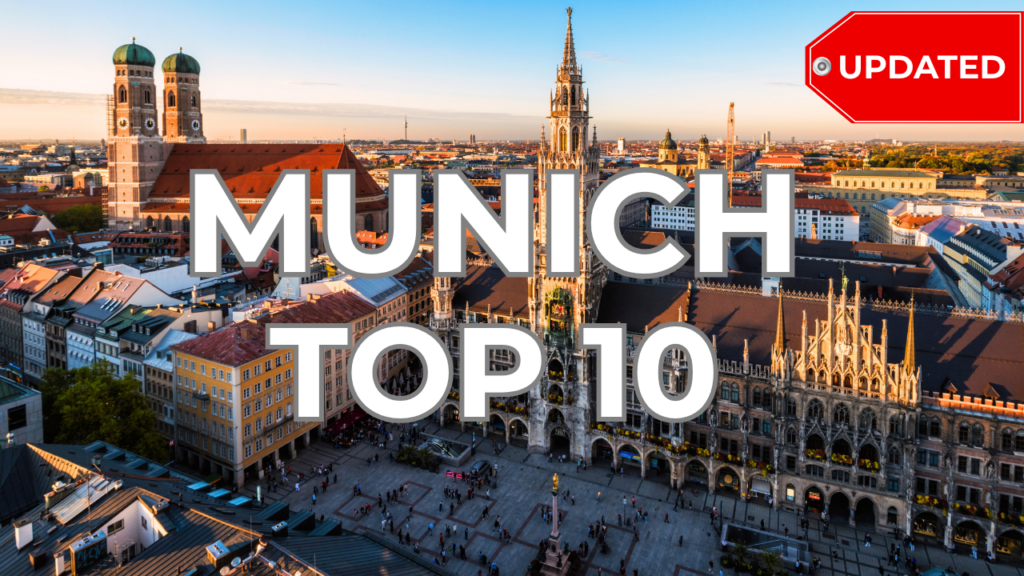
Munich is a city of contrasts – and that is exactly what makes Bavaria’s capital such an exciting destination.
Grand royal palaces stand only a short walk from lively beer halls. Surfers ride a river wave in the middle of the city, while some of Germany’s most important museums explore everything from science and technology to cars and Bavarian history. Add beautiful parks, traditional food markets, football culture and the Bavarian Alps within easy reach, and Munich offers far more than many first-time visitors expect.
If you are planning your first trip to Munich – or simply want to make sure you don’t miss the highlights – this guide takes you through ten of the best places to see and things to do in and around the city.
Rather than simply listing attractions, we also want to help you plan your visit. You’ll find our tips on what to look out for, which attractions work particularly well together and links to official sources where you can check current opening hours, tickets and visitor information.
So, let’s explore Munich – starting with number 10.

10. English Garden – Munich’s Green Escape

The English Garden, or Englischer Garten, is much more than a city park. Stretching from close to Munich’s historic centre far into the north of the city, it combines open meadows, woodland, waterways, beer gardens and some surprisingly unusual attractions.
Created in the late 18th century, the park was designed in the natural style of an English landscape garden rather than the formal geometric style associated with traditional French gardens. Today it is one of Munich’s most popular places to walk, cycle, relax and simply experience the city at a slower pace.
One of the best viewpoints is the Monopteros, a small Greek-style temple standing on a hill above the surrounding meadows. From here, you can look across the park towards Munich’s historic skyline.
Another landmark is the Chinese Tower, surrounded by one of the city’s best-known beer gardens. Further north, the Kleinhesseloher See offers another attractive place for a break.
The Eisbach Wave – Surfing in the City
The most unusual sight in the English Garden is found near its southern entrance.
The Eisbachwelle is a standing river wave where experienced surfers ride the fast-moving water only a short distance from Munich’s historic centre. Watching them from the bridge has become an attraction in its own right.
The wave has experienced temporary closures and changes in recent years. Surfing was officially permitted again in May 2026 after a stable, naturally formed wave returned. Because conditions and regulations can change, check the official information before your visit.
And one important distinction: watching the surfers is easy, but the Eisbachwelle is not a beginner surf spot.
TRAVELYVISTA TIP
Don’t treat the English Garden as something you have to “complete”. If your time is limited, explore the southern section around the Eisbachwelle and Monopteros. If you have more time, continue towards the Chinese Tower and Kleinhesseloher See.
It is also an excellent place to build a break into a full sightseeing day.
Official visitor information:
https://www.munich.travel/en/pois/sports-leisure/english-garden
Current Eisbachwelle status and rules – City of Munich:
https://stadt.muenchen.de/news/surfen-eisbach-erlaubt.html

9. Marienplatz – The Historic Heart of Munich

If there is one place that feels like the centre of Munich, it is Marienplatz.
For centuries, this square has been at the heart of city life. Today it is surrounded by some of Munich’s most recognizable architecture and is an ideal starting point for exploring the historic centre on foot.
The dominant landmark is the New Town Hall, or Neues Rathaus, with its elaborate Gothic Revival façade and famous Glockenspiel.
The Glockenspiel contains 43 bells and depicts scenes connected to Munich’s history, including the wedding of Duke Wilhelm V and Renata of Lorraine in 1568 and the traditional Schäffler dance.
Performances take place at specific times during the day, with additional performances during part of the year. Rather than planning around potentially outdated times, check the official Munich information shortly before your visit.
At the centre of Marienplatz stands the Mariensäule, while the surrounding pedestrian streets lead towards many other Old Town sights.
Look at Munich from Above
Marienplatz is also a good place to change perspective.
You can look down over the square and Munich’s rooftops from the tower of the New Town Hall. Another classic viewpoint is nearby St. Peter’s Church, although reaching its viewing platform involves climbing more than 300 steps.
On a clear day, the views can extend far beyond the historic centre towards the Alps.
TRAVELYVISTA TIP
Use Marienplatz as the starting point for a larger Old Town walk rather than visiting the square in isolation.
From here you can easily continue towards the Frauenkirche, Viktualienmarkt, Hofbräuhaus and Munich Residenz. Several attractions from this Top 10 can therefore be combined without using public transport.
Official information about Marienplatz:
https://www.munich.travel/en/pois/urban-districts/marienplatz
Official Glockenspiel information:
https://www.munich.travel/en/topics/urban-districts/glockenspiel-new-city-hall
8. Nymphenburg Palace – Royal Munich

For a very different side of Munich, head west of the city centre to Nymphenburg Palace.
Construction began in 1664 after the birth of the long-awaited heir Max Emanuel to Elector Ferdinand Maria and Henriette Adelaide of Savoy. What began as a summer residence developed over generations into an extensive royal palace complex.
One of the highlights inside is the magnificent Great Hall, whose Rococo decoration was created in the 18th century. Remarkably, its historic appearance has been preserved largely unchanged since 1758.
Another famous room contains King Ludwig I’s Gallery of Beauties, with portraits painted primarily by Joseph Stieler. The collection includes women from different social backgrounds rather than exclusively members of the aristocracy.
Nymphenburg also has an important connection to another person you will meet again at number one on our list: King Ludwig II was born here in 1845.
Don’t Stop at the Palace
The palace is only part of the experience.
Behind it lies an extensive landscaped park containing canals, lakes and smaller palace buildings, including Amalienburg, Badenburg and Pagodenburg.
Some areas and park buildings can be subject to seasonal access or restoration work. That is another reason we recommend checking the official visitor page rather than relying on fixed opening information in a travel article.
TRAVELYVISTA TIP
Allow enough time for the park. Visiting only the main palace gives you just part of the Nymphenburg experience.
If you enjoy architecture, gardens and royal history, this is one attraction where slowing down pays off.
Official visitor information and current access details:
https://schloss-nymphenburg.de/englisch/tourist/index.htm
Official ticket information:
https://www.schloss-nymphenburg.de/englisch/tourist/admiss.htm
7. BMW Museum & BMW Welt – Munich’s Automotive Side

Munich’s identity is not defined only by royal history and Bavarian traditions. It is also closely connected with engineering and the automotive industry.
Next to BMW’s distinctive four-cylinder headquarters, the BMW Museum explores the development of the company, its vehicles, motorcycles, design and technology.
Around 125 significant automobiles, motorcycles and engines are presented within the museum, while permanent and temporary exhibitions explore different aspects of the BMW story.
Even if you are not a dedicated car enthusiast, the combination of industrial design, technology and architecture makes this part of Munich worth considering.
BMW Museum or BMW Welt?
These are two different experiences and are located next to each other.
The BMW Museum focuses on the history, vehicles and development of the brand.
BMW Welt, meanwhile, is a modern experience and delivery centre where current BMW Group brands and technologies are presented. Entry to BMW Welt itself is free at the time of writing.
Because exhibitions, tours and visitor arrangements can change, use BMW’s official website for current details.
Combine It with Olympic Park
BMW Museum and BMW Welt sit directly beside Olympic Park, making this one of the easiest sightseeing combinations outside the Old Town.
If you are interested in architecture, cars, sport or modern Munich, you can easily spend a substantial part of a day in this area.
TRAVELYVISTA TIP
If you have limited time, decide beforehand whether your priority is the historical museum, BMW Welt or both. That prevents a short visit from unexpectedly turning into half a day.
Official BMW Welt & BMW Museum visitor information and tickets:
https://www.bmw-welt.com/en/index.html
6. Viktualienmarkt – Taste Munich

Just a few minutes on foot from Marienplatz, Viktualienmarkt brings you directly into Munich’s food culture.
The market dates back to 1807, when King Max I Joseph ordered the area to be used as a food market.
Today, around 100 stalls sell fruit and vegetables, bread, meat, fish, cheese, spices, delicatessen products, flowers, gifts and Bavarian specialities.
But Viktualienmarkt is more than somewhere to buy groceries. It is a place to slow down, look around and experience a more everyday side of central Munich.
One of its most recognizable features is the maypole, decorated with scenes connected to Munich life and brewing traditions.
And, naturally, there is also a beer garden.
A Market with a Munich Twist
The beer garden at Viktualienmarkt has an unusual feature: beers from Munich’s major breweries are served on a rotating basis.
That makes the market a particularly good place to combine sightseeing with a food or drink break without leaving the Old Town.
TRAVELYVISTA TIP
Don’t schedule Viktualienmarkt as a five-minute photo stop. Visit when you actually want a snack, lunch or simply time to browse the stalls.
It combines particularly well with Marienplatz and the surrounding Old Town.
Official visitor information and current market details:
https://www.munich.travel/en/pois/urban-districts/viktualienmarkt
5. Deutsches Museum – Science and Technology on Museum Island

If you are interested in science, engineering or technology, the Deutsches Museum deserves considerably more than a quick visit.
Founded in 1903, it has developed into one of Germany’s major museums of science and technology.
The main museum on Munich’s Museumsinsel is currently undergoing a major long-term modernization programme. Rather than closing the entire museum, the project has been structured so that significant parts remain accessible while other sections are renewed.
At present, visitors can explore 20 permanent exhibitions across approximately 20,000 square metres.
Subjects range from astronautics, aviation and robotics to chemistry, mathematics, optics, musical instruments, health, electronics, agriculture and food.
Among the objects and experiences are historic aircraft, the first diesel engine, robotics exhibits, a model railway and numerous interactive displays.
Why You Should Check Before Visiting
This is one attraction where older travel guides can become misleading.
The museum’s modernization is continuing, and additional exhibition space is planned to open as the project progresses. For that reason, we deliberately do not provide a fixed list of everything that will be accessible when you visit.
Instead, use the museum’s current exhibition overview immediately before your trip.
How Much Time Should You Allow?
The Deutsches Museum itself points out that two hours can pass very quickly and that many visitors spend much longer.
Our advice is therefore simple: choose your priorities before you arrive.
Trying to see everything can turn an interesting museum visit into a race through the building.
TRAVELYVISTA TIP
Open the current exhibition overview before your visit and select a few areas that genuinely interest you. Families should also look at the current information for the Kids’ Kingdom.
Official visitor information:
https://www.deutsches-museum.de/en/museum-island/visit
Current exhibitions:
https://www.deutsches-museum.de/en/museum-island/exhibitions
Modernization project:
https://modernisierung.deutsches-museum.de/en/
4. Allianz Arena – Home of FC Bayern Munich

Few modern buildings are as closely associated with Munich as the Allianz Arena.
Its distinctive exterior has made it a landmark in its own right, but for football fans the real attraction is what happens inside: this is the home stadium of FC Bayern Munich.
For domestic matches, the stadium has a capacity of 75,024 spectators.
You do not necessarily need a match ticket to experience the stadium. Official arena tours provide access to areas that ordinary spectators may not normally see, while the FC Bayern Museum tells the story of the club from its founding in 1900 through its many domestic and international successes.
Match Day or Stadium Tour?
These are very different experiences.
A match gives you the atmosphere of the Allianz Arena at its most intense. A stadium tour, on the other hand, provides a behind-the-scenes look at the building itself.
Tour routes and access to individual areas can change because of matches, events, safety requirements or renovation work. For that reason, always check the official Arena website before planning your visit.
TRAVELYVISTA TIP
If an Arena Tour is important to you, plan ahead rather than simply travelling to the stadium and hoping to join one. Availability can be limited and individual areas may occasionally be unavailable.
Also check the match calendar: visiting the area on a major match day is a very different experience from visiting on a normal sightseeing day.
Official Allianz Arena visitor information, tours and museum:
https://allianz-arena.com/en/tours-museum
3. Munich Residenz – Centuries of Bavarian Royal Power

From 1508 until 1918, the Munich Residenz served as the seat of government and residence of Bavaria’s dukes, electors and kings.
What began with an earlier medieval castle grew over centuries into an enormous palace complex in the heart of Munich.
Today, walking through the Residenz is like moving through different chapters of European architectural history. Renaissance rooms lead into Baroque, Rococo and Neoclassical interiors, reflecting the changing tastes and ambitions of the Wittelsbach rulers.
The Antiquarium
One of the absolute highlights is the Antiquarium.
Built between 1568 and 1571, the hall is 66 metres long and is the oldest room in the Munich Residenz. Originally designed to display Duke Albrecht V’s collection of antique sculptures, it was later transformed into an impressive ceremonial and banqueting hall.
Its scale alone makes it one of the most memorable interiors in Munich.
Other parts of the complex include the Treasury and the Cuvilliés Theatre, so it is worth deciding in advance how deeply you want to explore the Residenz.
TRAVELYVISTA TIP
Do not underestimate its size.
If you are primarily interested in the famous interiors, identify your priorities before entering rather than trying to rush through the entire complex.
The Residenz is also ideally located for combining with the Hofgarten, Odeonsplatz, Marienplatz and Hofbräuhaus.
Official visitor information:
https://www.residenz-muenchen.de/englisch/tourist/
Official ticket information:
https://www.residenz-muenchen.de/englisch/tourist/admiss.htm
2. Hofbräuhaus – Munich’s Most Famous Beer Hall

Few places represent the popular image of Munich as instantly as the Hofbräuhaus.
Its history goes back to 1589, when Duke Wilhelm V founded the Hofbräuhaus to supply beer to the Bavarian court.
In 1828, King Ludwig I opened the Hofbräuhaus to the public as a tavern – helping to create the institution visitors know today.
Inside, long communal tables, traditional food, beer and Bavarian music create an atmosphere that is deliberately very different from a quiet museum visit.
It is undoubtedly touristy – but it is also part of Munich’s history and remains one of the city’s best-known meeting places.
How to Approach a Visit
You do not need to turn a visit into an entire evening.
For many first-time visitors, simply stepping inside, experiencing the main hall and staying for a drink or meal is enough to understand why the Hofbräuhaus became so famous.
The ground-floor Schwemme uses free seating, so finding a place can be part of the experience. Reservation arrangements differ between areas of the building, which is another reason to check the official information if you are planning a particular meal or visiting with a group.
TRAVELYVISTA TIP
The Hofbräuhaus is only a short walk from Marienplatz and Munich Residenz. That makes it much easier to incorporate into an Old Town sightseeing day than to treat it as a separate excursion.
And remember that communal tables are part of traditional beer-hall culture – sharing a table with people you have never met is completely normal.
Official Hofbräuhaus website:
https://www.hofbraeuhaus.de/en/
Current reservation information:
https://www.hofbraeuhaus.de/en/reservations/
1. Neuschwanstein Castle – A Fairytale Day Trip from Munich

Our number one is not actually in Munich.
But if you have enough time, Neuschwanstein Castle is one of the most memorable day trips you can make from the Bavarian capital.
Set dramatically above the village of Hohenschwangau near Füssen, with mountains and lakes surrounding it, Neuschwanstein looks almost too theatrical to be real.
And that was very much the point.
King Ludwig II of Bavaria commissioned the castle as a deeply personal retreat inspired by medieval legends, kingship and the world of Richard Wagner.
The foundation stone was laid on September 5, 1869.
Construction took much longer than Ludwig expected. The king eventually moved into parts of the castle in 1884, but he never saw his extraordinary project fully completed. Even after his death in 1886, parts of the complex remained unfinished or were completed in simplified form.
That unfinished history is part of what makes Neuschwanstein so fascinating.
Visiting the Interior
There is one particularly important thing to know before travelling there:
Neuschwanstein Castle can only be visited inside as part of an official guided tour.
Tickets are linked to a specific tour time, and the official administration recommends purchasing them in advance because of the large number of visitors.
We deliberately do not list ticket prices or fixed opening times here. Use the official pages below for current availability and visitor information.
Getting There from Munich
Neuschwanstein is a genuine excursion rather than another stop on a Munich walking tour.
Whether you travel independently or join an organized day trip, allow enough time not only for transportation but also for getting from Hohenschwangau up to the castle.
The surrounding landscape is part of the experience, so rushing there simply to photograph the façade and leave again misses much of what makes the destination special.
The Classic View
Many of the famous photographs of Neuschwanstein are taken from Marienbrücke, the bridge spanning the gorge near the castle.
Access to the bridge can be affected by weather, maintenance or safety conditions, so do not build your entire visit around the assumption that it will always be accessible.
TRAVELYVISTA TIP
If Neuschwanstein is one of the main reasons for your trip, book your castle visit before building the rest of that day around it.
Use only the official visitor information to check current ticket availability and access conditions.
And remember: Neuschwanstein is not “in Munich”. It is our number one day trip from Munich, and it deserves most of a day rather than being squeezed between other city attractions.
Official Neuschwanstein visitor information:
https://neuschwanstein.de/englisch/tourist/
Official ticket information:
https://www.neuschwanstein.de/englisch/tourist/admiss.htm
How to Plan Your Munich Sightseeing
Ten attractions do not mean ten separate trips across the city.
A smarter approach is to group places that naturally fit together.
Munich Old Town
Marienplatz + Viktualienmarkt + Munich Residenz + Hofbräuhaus
These four highlights are close enough to combine into one larger Old Town route. Add the Frauenkirche, Odeonsplatz or Hofgarten along the way and you already have the basis for a full sightseeing day.
Green Munich
English Garden + Eisbachwelle
Start near the Eisbach, continue into the park and decide how far north you want to explore. This works particularly well when you want a less structured half-day after museums or Old Town sightseeing.
Modern Munich
BMW Museum + BMW Welt + Olympic Park
These attractions sit close together and make a natural combination for anyone interested in cars, architecture, sport and modern Munich.
Royal Munich
Nymphenburg Palace + Munich Residenz
They do not sit next to each other, but together they tell two different parts of the Wittelsbach story: Nymphenburg as a summer residence and the Residenz as the dynasty’s central seat of government and power.
A Full-Day Excursion
Neuschwanstein Castle
Give it its own day whenever possible.
How Many Days Do You Need in Munich?
If this is your first visit, two to three full days in Munich give you much more freedom than trying to fit the city into a single day.
With only one day, concentrate on the Old Town and perhaps the southern part of the English Garden.
With two days, you can add one of the larger attractions such as Nymphenburg Palace, the Deutsches Museum or the BMW/Olympic Park area.
With three or more days, you can explore at a more relaxed pace and consider a full-day excursion to Neuschwanstein.
The right itinerary ultimately depends on what interests you most. Munich works equally well for history lovers, foodies, families, football fans, car enthusiasts and travellers who simply want to enjoy parks, cafés and Bavarian atmosphere.
Planning Your Trip to Munich?
Munich rewards travellers who look beyond a checklist.
Yes, you should see Marienplatz. Yes, Neuschwanstein is spectacular. And yes, experiencing a traditional beer hall is part of the fun.
But some of the best moments can be much simpler: watching surfers on the Eisbach, walking through the English Garden, browsing Viktualienmarkt or looking across Munich’s rooftops towards the Alps.
Use this Top 10 as a starting point, combine the attractions that fit your interests and leave some space in your itinerary to simply explore.
And because opening hours, tickets, restoration work and access conditions can change, use the official links throughout this guide for the latest visitor information before you go.
That way, you can spend less time searching – and more time enjoying Munich.
Watch Our Munich Travel Guide
See all 10 places from this guide in our Munich video and get a visual impression of the city, its highlights and our number one day trip.